Personal · · 16 min read
Advice to My Younger Self
Fifty things I would tell my younger self, from pensions and emergency funds to sunscreen, boundaries, and uncomfortable conversations.
Photograph © Ken Reid
Advice to My Younger Self
Trigger warning: this post includes references to animal death.
If I could send a letter back (you know, one that didn't contain lottery numbers or "BUY BITCOIN"), this is what would be in it. These are in no particular order, and I intend to add to them as I feel like it. Some are practical and small, some are the kind of advice that is trite but for me at least contains further depth and meaning. I doubt any of them are original. I hope they're still worth sharing, and writing down.
Start the pension now. I know the number going in feels too small to matter, and I know the salary feels too small to spare. Put in what you can anyway. A pound invested at twenty-two does more work than a pound invested at thirty-five, because it has thirteen extra years of compounding, earning returns on its own returns, year after year. By the time you can comfortably afford to put in a meaningful amount, the early small contributions will have already grown past what your later, larger ones can match.
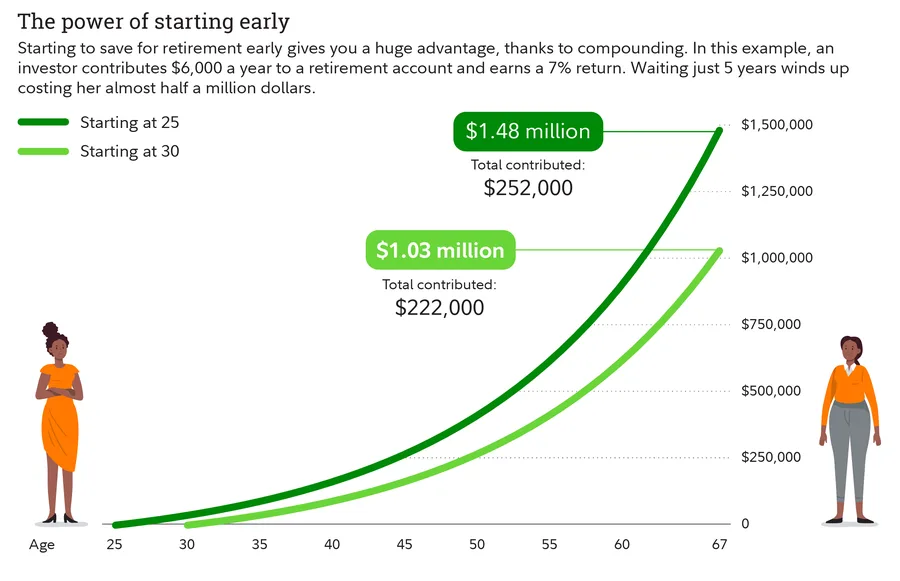
Credit: Fidelity. This looks like an ad but it isn't. Build the savings pots in order. Emergency fund first: it gets touched for vet bills, hospital bills, and a roof that has stopped being one. Not video games or "aw man I want to go on that night out with my friends but I have no money, except I do....". Once that pot covers a month of expenses, start an unemployment fund and aim for one month of living costs, then six. While working on the unemployment fund all the way to six, branch off a third pot, call it the big-time fun fund, and split your savings rate fifty-fifty between the two. Weddings, vacations, etc. Good savings account for disasters but also for enjoying life.
Stop buying the cheapest version of everything. A £50 vacuum you replace five times in two years costs more than a £175 vacuum bought once. The rule is not "spend more.", it's "buy things you can repair or reuse." Apply it to plates, a vacuum, a desk chair that supports your back through homework and a career, a mattress, and a gym membership, because your health is the thing you are most likely to underspend on and most likely to regret underspending on. Eating well can be cheap if you buy in bulk, rather than buying cheap (buy oats!). And for clothes: one good piece per category and per social purpose beats a wardrobe full of items that shrink, tear, or unravel before the season ends. And buy wool, linen or cotton, avoid polyesters and other artificial materials.
Befriend people who are not like you. Different ages, different cultures, different backgrounds, different politics where the conversation is in good faith (also you can disagree without proving you're right, or even saying you disagree, and you can disagree without being disagreeable). You will grow more from the friction of being around people you do not immediately understand than from the comfort of being around people who already agree with you. The temptation to stay only inside the small circle you formed at eighteen is strong. Resist it.
You don't need to fix loneliness with a relationship. Build friendships and learn to like your own company first, and practise empathy on the people already in your life. The more deeply you understand people, the better you get at recognising who you actually want to be around, and the less you will settle for company that happens to be available. You're worth more than you think.
Read more. You loved it as a teenager and let it slip. Fifteen minutes a day is enough to start. And be less precious about genre, because there is a lot more out there than fantasy, even though you should keep reading fantasy too.
© Ken Reid. Go to the gym, or at least walk. Once nobody is making you do it, it becomes far too easy not to. Work will tire you and you will feel justified in skipping it. Go anyway! Exercise isn't about longevity of life, it's about quality of life.
Train for what your body needs to do, not for how it looks. Carrying a neighbour's furniture up three flights, staying on your feet through a long night at a hospital, being physically present when something needs doing. The mirror cannot tell the difference between that kind of preparation and posturing. Build for the work, not the display.
It is a shame for a man to grow old without seeing the beauty and strength of which his body is capable.
SocratesEarly in your career you are judged on small things: turning up on time, looking busy, being the kind of person colleagues like having around. Later, output is what gets you measured. Show face, keep your manager's life easy, and stop catastrophising every minor wobble. Things tend to work out. The harder job is keeping your enthusiasm alive when work tries to drain it in your 20s.
Be the person who takes the photos. You will regret trying to remember good times and they just merge together. Some photos help you find specific life events, moments, funny incidents.
Keep your old work. @ghostkat added this one on Cyberspace from an artist's angle, and I wish someone had said it to both of us: do not destroy your early creations. They are the record of your strengths and weaknesses, and the only proof of how far you have come since. Ghostkat has recovered scraps of their Web 1.0 art through web archives, but most of it is gone for good. The cringe you feel looking at old work is evidence of growth.
Write it down, not only photograph it. @cyberia suggested this one, also on Cyberspace: keep the stupid little stories that feel too small to matter. Days blur into years and then into decades, and eventually you will want to know what you were up to on a random Sunday at sixteen.
Wear sunscreen. If you hate the feel of it, you are using bad sunscreen. Find one that moisturises and you have no excuse left.
Moisturise. Also floss. A perfect dental record does not protect you if you stop maintaining it, and the cost of catching up after years of neglect is much higher than the cost of two minutes a night.
Keep playing guitar. Learn the boring parts too: theory, scales, chord names. The boring parts are what let you play with other people and write your own things instead of recycling the same Smashing Pumpkins songs for the rest of your life.
A weekend in a nearby town is a real holiday. You do not need to feel inadequate for not flying somewhere expensive, especially when you have not seen most of what people fly into your own country to see. Travel the place you live in first.
Sometimes paying for convenience is correct. The test is whether the time you save will be used for something worth more than the money you spent saving it. If you are paying for delivery so you can scroll your phone for an extra forty minutes, walk to the shop. If you add 3 stops on your flight, costing half the time you would be on vacation, pay the extra £250.
You eventually learn to fake confidence, and the faking turns into the real thing. Confidence isn't some inherent trait for most, it's a practiced skill. Practise public speaking. Practise introducing yourself to strangers. Practise disagreeing with someone in a way that does not require apologizing.
Don't compare yourself to other people. Compare yourself to who you were yesterday. The only measure that tells you anything useful is the gap between where you were and where you are now, and you are the only person running that race.

© Ken Reid. Keep a kit in the car: first aid, jumper cables that can start the car from a battery pack rather than another vehicle, a torch, a warm blanket, a handful of granola bars. You will need none of it most years and then one night you will be glad it was in the boot.
Change your car oil.
Do not be afraid of big changes. Ending a friendship that has gone bad, leaving a job, moving to a different country: these are rarely whim decisions. You will have thought about them for months by the time you act. If you have done the thinking, the fear is a separate problem.
Stop apologising for taking up space. Notice how often you say "sorry" when you mean "excuse me," "thank you for waiting," or simply "I am here." Save your apologies for the times you have caused harm, not for the times you have needs or boundaries.
Be wary of people who weaponise their mental health against yours. Real struggle is real and deserves care. Using therapy-speak as a permanent licence to behave badly is a different thing entirely. You are allowed to walk away from people who treat your wellbeing as collateral damage for their own. Even if they can put their experiences into nicely packaged mental health struggles justifying their actions, you are allowed to say no or leave without having to explain yourself. "I don't want to" is enough.
You do not need to have an opinion on everything. The internet will try to convince you that every global event, every celebrity story, every social issue requires an immediate public stance from you. "I do not know enough about this to have a take" is a complete sentence, and listening longer is often wiser than speaking sooner.
Learn to write a clear, persuasive, short email. Most important information at the top. Requests stated plainly. No overly polite padding. Proofread before you send. And know that sometimes the right email is two lines: "Hi. Tomorrow works. Ken." Brevity is a kindness to the person reading you, 3 lines explaining yourself is not a kindness.
Write the way you speak. Not the corporate version of yourself, not the academic version, not the version trying to sound impressive. If a sentence would feel strange said out loud at a dinner with a friend, don't put it in writing either. The best prose reads like an intelligent person talking to you about something they actually care about. This goes for academic writing, too, to an extent: explain things simply, use jargon when necessary, but avoid making it sound complex for the sake of it.
How well your life goes is largely a function of how many uncomfortable conversations you are willing to have. The salary you don't negotiate; the relationship you do not end; the friend you don't confront; the boundary you do not state. Every one of those is a problem you keep carrying because you chose discomfort later instead of discomfort now.
Accept help when it is offered. You will pay it back threefold to someone else later, when it is their turn.
Sometimes the fastest way out of your own problems is to help someone else with theirs. It interrupts the loop, gets you out of your head, and reminds you that you are still capable of being useful when your own situation feels otherwise.
Be the most reliably useful person in the room, not the most decisive one. That means reading what is actually needed rather than what you can demonstrate, taking on the weight that falls between the gaps, and stepping back without resentment when someone else is better placed. Social strength is not about being impressive; it is about making the people around you more capable.
Men exist for the sake of one another. Teach them then or bear with them.
Marcus Aurelius, Meditations
© Ken Reid. You are not as clever as you think. Listen more than you speak, especially in rooms where you are the youngest or the least experienced. The people who learned things the slow way will hand them to you for free if you give them a few minutes of genuine attention.
Do not be friends with people who drink and drive, or get high and drive. If you cannot avoid being friends with them, never get in their car.
Wanting a masculine role model is fine. Wanting one is not the same as picking one off YouTube. The compilations of "X gets owned by Y" are edited to remove every piece of context that would make Y look less clever and X look less foolish, and the algorithm rewards whoever produced the cleanest humiliation rather than whoever was right. Learn the common logical fallacies, learn how to read a primary source, and learn to sit with a topic long enough to understand it before you take a side, especially when the topic is something you have not lived and someone else has.

Credit: 3 Star Learning Experiences. When someone is upset, ask them: "Do you want advice, or do you want to vent?" It tells the person in front of you that you care enough to find out what they actually need instead of assuming. Most of the time the answer is "vent." Most of the time you would have given advice (you think solving the problem will make them feel better, instead of just trying to make them feel better).
Work very hard at caring less what people think. Not ignoring it; acknowledge the comment, look at it, decide whether it is useful criticism, jealousy, or somebody who simply does not like you, and then respond accordingly. You stop bleeding every time someone takes a swing, and the swings come less often, because hitting somebody who is not flinching stops being fun. And do not accept criticism from someone you would not accept advice from.
Treat yourself the way you would treat a friend who came to stay for the weekend. Put a glass of water on the desk. Stock the fridge with food that is actually good for you. Ask yourself how you are doing and listen to the answer. You would not let a friend skip meals, sleep four hours, and then tell themselves they are lazy for being tired. Do not let yourself do it either.
Do not let perfect stop you from starting. The clearest example for you is fitness. Five gym sessions a week, the right ratio of protein and veg after, fruit and carbs before, sleep perfectly optimized: that is a programme, and if you cannot run the whole programme you will tell yourself the whole thing is broken and skip the rest. A walk counts. A workout in the living room counts. A rest day counts, and important! A missed week is not lost progress unless you decide it is and stop progressing from there. The version of you who does something imperfect every week beats the version who waits for the conditions to be perfect.
Cats need annual dental check-ups. So do dogs. They are expensive and they are not optional if you want the animal to have a comfortable life. Being able to afford the food and the monthly costs is not the same as being able to afford a pet. You can afford a pet only if you can also afford the dental work, the insurance premiums, or the savings buffer for a major vet incident. Taking in an animal you cannot afford to keep healthy is not a kindness to the animal.
Be in the room when your pet dies. It is one of the hardest things you will be asked to do. They deserve to feel your hand and hear your voice as they go. You can fall apart afterwards, and you'll feel better knowing you were there for them as they were there for you.
The correct response to a compliment is "thank you." Not a self-mocking comment, not a joke, not a list of reasons the compliment is incorrect. Wriggling out of it is a symptom of your lack of self confidence, and acknowledging the compliment is a step towards building it.

© Ken Reid. Be kind, but know what you owe and what you do not. Western culture tends to tell you that you owe other people nothing, which is not true. Many eastern cultures tend to tell you that you owe other people everything, which is also not true. My answer is that you owe what you can give, and you are owed what you need. Your people should be there when you need them, and you should be there for your people as much as you can manage, and not an ounce more. "No" is a complete sentence. You do not have to provide a reason for most of the things you decline, and the instinct to explain yourself is usually about your own comfort rather than theirs.
Kindness and politeness are good things, and they are also the levers that certain people will use to move you. Stay kind. Stay polite. The moment somebody is using your kindness to take more than they are owed, close the door without apology and do it quickly; the longer you wait, the more they assume you are fine with it. In a similar vein, everyone deserves to eat at a table. It does not have to be your table. You can help someone find one, point them somewhere useful, even pay for the meal, without giving up your own safety or peace to do it.
No amount of logic will work on someone who did not use logic to arrive at the position. If the belief was assembled from fear, tribe, ego, or pure aesthetic preference, walking in with a tidy argument will not dismantle it. It will make them defend it harder. Pick your battles accordingly, and accept that some conversations are not arguments to be won.
There will be people who do not like you, and you do not need to win them over. There will be people you do not like, and you do not need to talk yourself into liking them. The energy you would have spent manufacturing mutual approval where none exists is better spent on the people who already like you, or on your own work. Be civil, be polite, and move on.
No one cares as much as you think they do. Walking into a room, leaving a lecture, heading to the buffet table: it feels like everyone is watching and evaluating you. Most people are thinking about themselves, their own nerves, and their own next move.
Trying to split every issue down the middle is not always wisdom. Sometimes there is no respectable midpoint between evidence and denial, between human dignity and pure profit. Fairness is not pretending both sides are equally valid when they are not.
Trust the feedback of people you trust. Driving, mounting a TV, seasoning food, choosing a shirt: second opinions from good people save you from avoidable mistakes. You do not need to do everything in isolation to prove competence.

© Ken Reid. Compartmentalising is a legitimate way to get across a difficult stretch. Putting your feelings in a box so you can function and carry on is sometimes what the situation calls for. The problem is when the box becomes permanent storage. The longer you carry it the more it hurts you, usually at the worst possible moment, when someone you love needs you to actually be present.
When you get broken, do the work of healing rather than pretending the wound is a callus. Scarring over is not the same as getting stronger. The strength worth having forms after the break, in the place where you were hurt and then tended to it properly.
The world breaks every one and afterward many are strong at the broken places.
Ernest Hemingway, A Farewell to ArmsThis too shall pass. Good seasons, bad seasons, embarrassment, grief, excitement, uncertainty: all of it moves. Do not build your identity around a temporary moment.
A bad mood is sometimes a choice. You like to grab it and hold onto it, same with depression at times. Sometimes we need to give into bad emotions and sulk; but many times you do it to an extreme. Recognize it, acknowledge it, and then let it go.
I hope there is something here you found useful. Let me know your thoughts and if there's anything you'd add, let me know via social media, I'd love to have a conversation on how we can all grow and learn from each other. (This has already worked: two of the entries above came from readers on Cyberspace.)