Ideas · · 6 min read
Voyager Is Still Talking
Voyager 1 reached one light-day from Earth on 18 November 2026, 49 years after launch, and it's still calling home.
Photograph © Ken Reid
Voyager Is Still Talking
On Wednesday 18 November 2026 at 05:16 EST (10:16 UTC), Voyager 1 became the first human-made object one light-day from Earth, 16.09 billion miles (25.90 billion km) away, so a radio signal takes 24 hours to reach it and another 24 hours to come back. It's a bit mind-boggling, these figures: our short-term memory generally can only handle about 4 things at once, and 16 billion miles are many more than that. It launched in 1977 on a mission that was meant to last five years and crossed out of the Sun's wind into
It's the furthest we've ever sent anything out there into the deep dark nothing, and, crazily, it was built before almost anyone had a computer at home, and it's still talking to us. Old Star Trek vibes, right?
Quick jargon guide
- RTG (radioisotope thermoelectric generator): Voyager's power source, which turns the heat of decaying plutonium into electricity. No sunlight needed, and it fades slowly and predictably.
- Interstellar medium: the space between stars, beyond the bubble of the Sun's influence (the heliosphere). Voyager 1 crossed into it in 2012.
- Deep Space Network: the array of giant radio dishes on Earth that still hears Voyager.
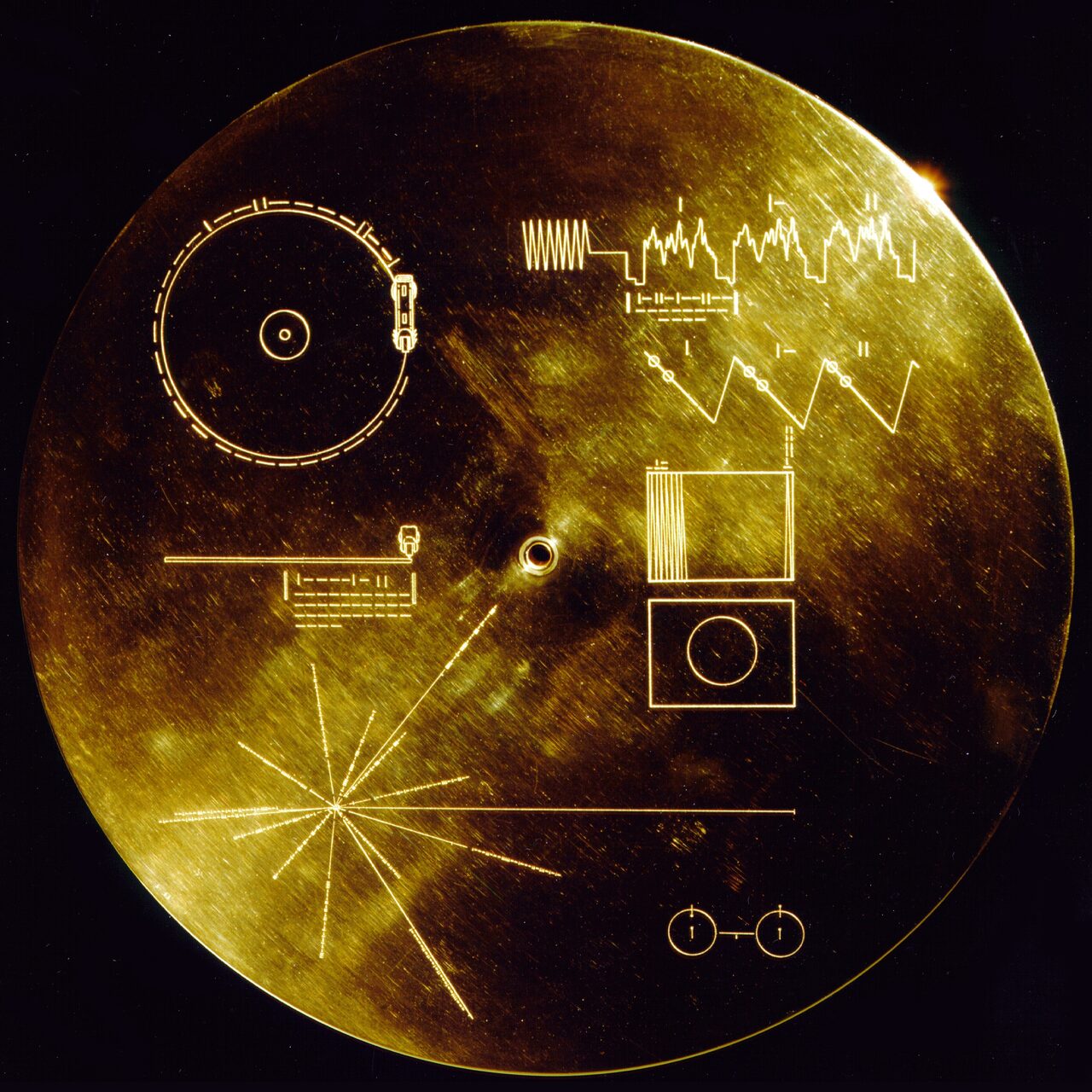
- The Golden Record: the phonograph record bolted to each Voyager, carrying sounds and images of Earth for any finder.
- Light-day: the distance light travels in a day, about 25.9 billion kilometres. From 18 November 2026, Voyager 1's signal takes a full day to reach us.
Four watts a year
The Voyagers were built to last five years, long enough to get past Jupiter and Saturn, and they have been running for nearly fifty, which sounds a lot like the little huts my high school built to last something like 5 years then used for 25 (shoutout Glenrothes High School!). Their
The six computers on each probe have just under 70KB of memory between them, which is much less than a photo taken on an average iPhone or Android device. They are programmed in languages the current team sometimes has to learn from retired engineers and the original paper manuals (Voyager-specific assembly language). When something breaks more than 25 billion kilometres away, the fix gets radioed out and takes a day to arrive, and then it's another day before anyone on Earth finds out whether it worked.
It's still alive because of various interesting reasons. 1. Somebody in the 1970s built in big safety margins, kept the design simple and put in a spare for nearly everything. 2. Due to the hardware of the time being more physical, it's less vulnerable to radiation and bit flips than our current technology is in space, and 3. it was put together carefully, because a huge amount of effort and funding had to be found for a project like this, so everything was checked and tested dozens of times as individual components and in integrated fashion before, during and after launch. After it goes silent it will keep drifting, intact, for longer than our species has existed and probably will exist.
The message bolted to the side
Each Voyager also carries the
As engineering, the record was close to pointless. The chances of anyone finding either probe round to zero, judging by how empty the universe appears to be, and neither will come near another star for tens of thousands of years.
I think the record was always for us more than for anyone out there. In 1977 (which was in the middle of the Cold War), with both sides pointing thousands of nukes at each other, a group of people sat down, decided on some of the most human sounds and sights there are and blasted them off into space to last forever.
It's a lovely sentiment, though it reads a fair bit differently if you think of it with the Fermi paradox in mind. The dark forest idea (that any civilisation which announces itself gets wiped out by a more careful one) has unsettled, well, anyone who knows of it. Some serious people think we'd have been wiser to stay silent, but ultimately, we already broadcast ourselves via light, radio, and many other ways which we haven't taken any steps to prevent. So I think this can be left as a time capsule for another species to find, and who knows, maybe we'll be their first contact.
Common questions
How much longer will the Voyagers keep working?
Not much longer. The generators lose about 4 watts a year and the team keeps switching instruments off to stretch what's left, so the end of useful science is somewhere around the late 2020s to early 2030s (NASA thinks the Deep Space Network can hear them until about 2036), and after that they go silent and just coast on forever (or till gravity pulls them somewhere they will burn up and cease to be).
Will the Golden Record actually last, physically?
Yes. With almost nothing out there to erode them apart from the odd micrometeorite and slow cosmic-ray damage, the gold-plated records should stay readable for hundreds of millions of years, possibly more than a billion, by which time we'll be long gone.
Given the dark forest worry, was broadcasting our location a mistake?
Probably not, in practice. The record does carry a map to Earth (via pulsar positions), but two slow, passive probes are far harder to spot than the radio and radar we leak into space every day, so I see it as a symbolic act more than a security decision.
References
- NASA Jet Propulsion Laboratory. Voyager mission status and updates. https://voyager.jpl.nasa.gov/ (check for current power levels, active instruments, and distance, which change over time).