The Paradox of Tolerance
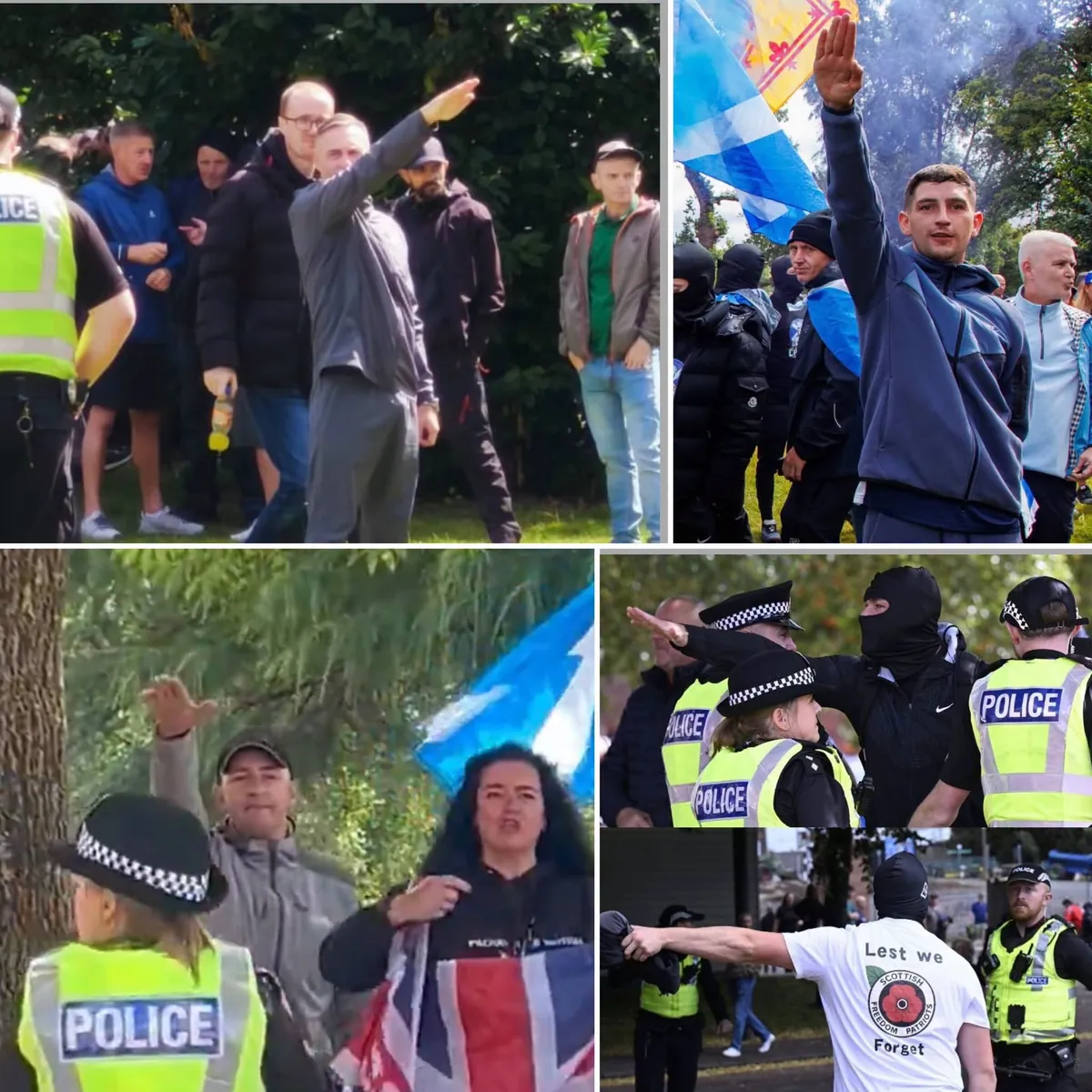
On the banks of the Clyde in Glasgow there is a statue of Dolores Ibárruri, La Pasionaria, arms raised, with an inscription that reads "better to die on your feet than live forever on your knees". It honours the Glaswegians who volunteered to fight Franco's fascists in Spain in the 1930s, many of whom did not come home. In late July 2026, a short walk upriver at Glasgow Green, people at a rally were filmed performing Nazi salutes, and sadly more than one or two.
The rally was organised by a group calling itself Unite the Clans, and around 1,700 people, by Police Scotland's count, turned up. So did counter-demonstrations organised by Stand Up To Racism and Women Against The Far Right. By the end of the day, footage circulating online showed the salutes, a non-white delivery worker being assaulted, and a crowd chanting "send them home" at a black passerby. Police Scotland made fifteen arrests on the day, on charges including possession of an offensive weapon, assault, and breach of the peace, and said plainly that some attendees had arrived intending "pre-meditated disorder, violence and intimidation". The First Minister called it "a demonstration of far-right hatred". A Chief Superintendent called the scenes "nothing short of disgraceful" and promised those involved that officers would be knocking on their doors. All of this happened while Glasgow was hosting Commonwealth Games delegations from seventy-four nations.
I'm from Scotland. I grew up on the story that Scotland was always the "open arms" country, and the English were the racist, anti-immigrant fannies down south. I remember when I was younger, a teenager, I had a lot of arguments with friends and online on forums about freedom of speech. I was always told that Americans have "true" freedom of speech and can't be arrested for anything they say, while in the UK we are limited in what we can say. But the only examples these people could come up with were slurs, or inciting violence. They argued that "true freedom" should allow anyone to speak and say anything, and it has some merit, at least at first glance. This brings us to the topic of this article: the paradox of tolerance, which I think is widely misunderstood by both the people who invoke it and the people who dismiss it.
Quick jargon guide
- Paradox of tolerance: the observation that a society which tolerates absolutely everything, including movements that aim to end tolerance, will eventually be destroyed by them. Total tolerance is therefore self-defeating.
- The Open Society and Its Enemies: Karl Popper's 1945 defence of liberal democracy, written in exile during the war. The paradox appears in a footnote.
- Militant democracy: the idea, born from Weimar Germany's collapse, that democracies may restrict the rights of movements that would abolish democracy itself. Modern Germany is built on it.
- Stirring up hatred: the criminal offence category in Scotland's Hate Crime and Public Order (Scotland) Act 2021, in force since 2024, covering threatening or abusive behaviour intended to stir up hatred against protected groups.
- Overton window: the range of ideas considered publicly acceptable at a given moment. It moves, in both directions, depending on what goes unchallenged.
What Popper actually wrote
Karl Popper was a Viennese philosopher of Jewish descent who fled Austria ahead of the Anschluss and spent the war years teaching in New Zealand, writing what he called his "war effort": a philosophical defence of open societies against their enemies. The Open Society and Its Enemies came out in 1945. The famous passage is not in the main text, it sits in a footnote to chapter seven, as if Popper considered the point almost too obvious to argue at length:
Unlimited tolerance must lead to the disappearance of tolerance. If we extend unlimited tolerance even to those who are intolerant, if we are not prepared to defend a tolerant society against the onslaught of the intolerant, then the tolerant will be destroyed, and tolerance with them.
— Karl Popper, The Open Society and Its Enemies
It fits on a placard and it appears in my social media feeds every time something like Glasgow Green happens. But Popper kept writing:
In this formulation, I do not imply, for instance, that we should always suppress the utterance of intolerant philosophies; as long as we can counter them by rational argument and keep them in check by public opinion, suppression would certainly be most unwise. But we should claim the right to suppress them if necessary even by force; for it may easily turn out that they are not prepared to meet us on the level of rational argument, but begin by denouncing all argument; they may forbid their followers to listen to rational argument, because it is deceptive, and teach them to answer arguments by the use of their fists or pistols. We should therefore claim, in the name of tolerance, the right not to tolerate the intolerant.
— Karl Popper, The Open Society and Its Enemies
Popper is not saying "silence anyone whose views you find intolerant". He is saying almost the opposite: while a movement is willing to argue, argue back, and suppression is "most unwise". The right to suppress is held in reserve for the moment a movement exits the argument, when it answers speech with fists.
The peace treaty framing
The cleanest way out of the paradox is to stop treating tolerance as a virtue and start treating it as an agreement, a reframing I owe to Yonatan Zunger's essay "Tolerance is not a moral precept", which calls tolerance a peace treaty, and reminds us that a peace treaty is not a suicide pact. A virtue is something you must extend to everyone unconditionally, which is how you end up handing a microphone to people who want you dead. An agreement, however, is different. Tolerance is a mutual pact: I accept your right to live as you choose, and you accept mine. Like any pact, it protects the people who keep it. Someone who performs a Nazi salute in a public park is not exercising the pact; they are announcing, in the most legible gesture the twentieth century produced, that they have left it. The paradox dissolves once you see it this way. You are not being intolerant when you refuse to tolerate fascism, any more than you are being violent when you defend yourself from a punch.
I like this framing because it answers the smug gotcha ("so much for the tolerant left!") without any philosophical hand-waving, and because it matches how every other agreement in life works. Nobody thinks a referee is betraying the spirit of football by ever sending players off.
Where the threshold sits
Drawing the line too tightly is of course problematic, where every uncomfortable opinion becomes "intolerance" and suddenly a government can use "hate speech" as a silencing tool. This is the slippery slope the free speech absolutists worry about. Whoever holds the definition of "intolerable" today will not hold it forever, and a rule you would not want your worst enemy to wield is a rule you should hesitate to create. It's why Popper's default is argument and public opinion, with suppression as a reserve power rather than a first resort.
Drawing the line so loosely that nothing short of actual violence ever crosses it, by which point the argument phase is long over, is also problematic. Weimar Germany had a liberal constitution, a functioning press, and elections, and a movement that used all three while openly promising to abolish them. The people who watched that happen did not conclude that more debate was needed. Post-war Germany clearly learned this lesson, as exhibited by their new laws: the Nazi salute is a criminal offence, parties hostile to the constitutional order can be banned, and this framework (they call it militant democracy) has coexisted with one of the freest societies in Europe for eighty years. The slippery slope has guardrails you can build.
A salute that means "the Holocaust was good, actually", performed by a crowd that assaulted a delivery worker for his skin colour, is not a contribution to public discourse that we must meet with rational argument. It is the fists-instead-of-arguments moment Popper described. The counter-protesters, the fifteen arrests, and the door-knocking that Police Scotland promised are society using proportionate, lawful force to defend the conditions under which everyone else gets to keep arguing. But I don't think this is the end of it.
What Scotland's law actually does
People are often surprised to learn that the UK, unlike Germany, does not ban the Nazi salute as a gesture. What we have instead is a patchwork: public order offences covering threatening and abusive behaviour, and in Scotland the Hate Crime and Public Order (Scotland) Act 2021, which since 2024 has criminalised behaviour intended to stir up hatred against protected groups. Whether a given salute is criminal depends on context: who saw it, what accompanied it, what it was intended to do. This context-sensitivity is frustrating to people who want a bright line, but it is also recognisably Popper's structure translated into statute: the gesture alone is speech, the gesture as part of an intimidation campaign is conduct, and the law reserves its force for the latter. A teacher showing a class what the salute is and educating on the fascism that it implies is very different from a crowd doing it at an anti-immigration (or really, anti-black) rally.
Whether the patchwork is enough is a live political question in Scotland right now. What I am confident about is the direction of the burden. The question is not "can we justify restricting the fascists?" It is "can a society that watched the twentieth century happen justify treating open fascist organising as ordinary politics?" Eighty years of German experience says restriction is compatible with freedom. Ten years of watching the far right grow on unmoderated platforms says indifference is not.
The view from the receiving end
On the Saturday afternoon of the rally, a 31-year-old delivery driver named Muhammad Jawad Yaqoob picked up an order from the Palm Tree Kitchen on Bridge Street, just south of the river, as dozens of demonstrators went past chanting "get them out". He later told the BBC what happened next: a man shouted "you brownie, you Asian, you Pakistani" at him, and another threw a traffic cone at him while the group cheered. He ran behind a nearby restaurant. Then his phone buzzed: Uber's app, knowing nothing, was asking him to complete the delivery. So he did. He delivered the food, went back to ask the shop for CCTV footage (it had none), and reported the attack to the police anyway.
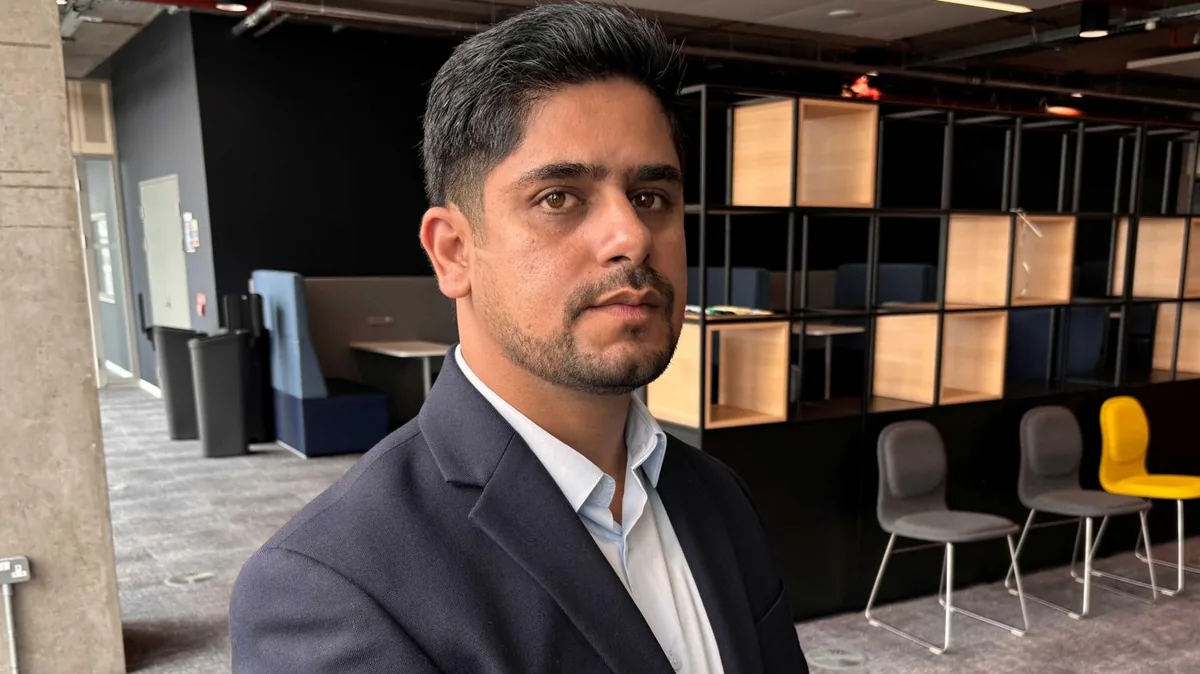
By the time he got home, footage of the attack had spread across social media, as far as Pakistan, where he is from. Days later he had still not returned to work, though he knows he will have to: "I have bills to pay so I can't just sit at home." He told the BBC that until that weekend he had found Glasgow a friendly place. "Everybody gives me tips on my deliveries and says hello, greeting me with smiley faces. But after this incident I feel scared, I don't feel like I know this version of Glasgow. Police have not protected me and there has been no further action." Fifteen arrests on the day is the aggregate response working roughly as designed. The man who threw the cone was, as of the BBC's report, still only "being investigated". Society-level self-defence and individual protection are not the same thing, and the gap between them is where people like Yaqoob actually live.
Edit, 11 August 2026: a 29-year-old man has since been arrested and charged with racially aggravated assault over the Bridge Street attack, and the Glasgow Times has published video of police breaking down his door. The paragraph above stands as written on 2 August.
Dr Zubir Ahmed, the Labour MP for Glasgow South West, asked the question this whole essay has been circling: "How did we get here? How have we reached a point where people in one of the most diverse communities in Scotland now think twice about stepping outside?" His answer is accurate: "We've been sold a story about ourselves: that racism here in Scotland isn't really as bad." And: "We fix nothing by fooling ourselves that we're better than others." A self-image inherited from your grandparents is not a property you personally possess; it is a standard you either meet or fail. The Justice Secretary, Neil Gray, promised that "people will be brought to justice". Yaqoob, whose attacker cheered and walked away, is still the one attacked in the street, still afraid to go to his job, while we discuss political philosophy. That makes me feel deep shame in the systems in Scotland that fail to protect and help people like Yaqoob thrive. It makes me feel a deep sadness for what I thought I missed: a Scotland that is welcoming, arms open to people who aren't part of its white majority. It makes me wonder if I'd return with my partner, who, unlike me, is not Scottish and is not white. Would Scotland be a welcoming place for her like I thought, or would she be attacked on the street?
The part that is ours to do
Popper's first line of defence was "rational argument and public opinion", which is to say: us. The Overton window moves because ordinary people recalibrate what they will let pass in a pub, a group chat, a family dinner, a football stand. Every "it's just banter" is a data point in someone's model of what this society permits. The counter-demonstration is the visible version of this, and Glasgow's showed up in numbers.
La Pasionaria's statue has stood on the Clyde since 1980, paid for by public subscription because the city council of the day would not fund it, which is its own reminder that Glasgow's anti-fascism was always the people's project before it was official. The men it commemorates did not go to Spain because they had read the footnotes of a book that would not be written for another decade. They went because they understood, without needing the philosophy, that some movements do not stay in the argument phase, and that the time to stop them is while stopping them is still cheap. The salutes at Glasgow Green are a test of whether we still understand it.
Common questions
Isn't "not tolerating intolerance" just censorship with better branding?
Popper's explicit default is to counter intolerant ideas with argument and public opinion, and he calls suppression of mere utterance "most unwise". The reserve power applies when a movement abandons argument for intimidation and violence, which is a conduct test, not an opinion test. A society that suppresses views it merely dislikes has misread the paradox; a society that cannot defend itself against organised political violence has also misread it.
Doesn't banning symbols just make martyrs and drive movements underground?
Sometimes, which is why context matters more than blanket bans. But the strongest counter-evidence is Germany itself: the country with the strictest prohibition on Nazi symbols has spent eighty years as a stable, free democracy, and its far right organises around the ban's edges rather than gaining strength from it. Meanwhile the "sunlight is the best disinfectant" theory has had an extended, well-funded trial on global social media platforms, and the results are not encouraging. Sunlight disinfects arguments; it also feeds propaganda.
Is a Nazi salute actually illegal in Scotland?
Not as a gesture in isolation, unlike in Germany or Austria. It can be criminal in context: as threatening or abusive behaviour under public order law, or under the stirring-up-hatred offences in the Hate Crime and Public Order (Scotland) Act 2021, depending on intent and circumstances. That is why the arrests at Glasgow Green were for offences like assault, weapons possession, and breach of the peace rather than "saluting". Whether Scotland should follow the German model is a live debate.
What should I actually do when I see this stuff?
Don't share the footage raw (it is often the recruitment material the organisers wanted); report identifiable crimes to Police Scotland; support the organisations that do the unglamorous monitoring work, like HOPE not hate; show up to counter-demonstrations if you safely can, because turnout numbers are the message; and hold the line in the small rooms, the pub and the group chat, where the Overton window actually lives. The culture is handled by us or not at all.
Hero image: Arthur Dooley's La Pasionaria memorial to the International Brigades on Custom House Quay, Glasgow. Photograph by Alex Liivet, via Wikimedia Commons (CC0, public domain).