Data & AI · · 11 min read
Evolutionary Computation's Identity Crisis in the Age of GenAI
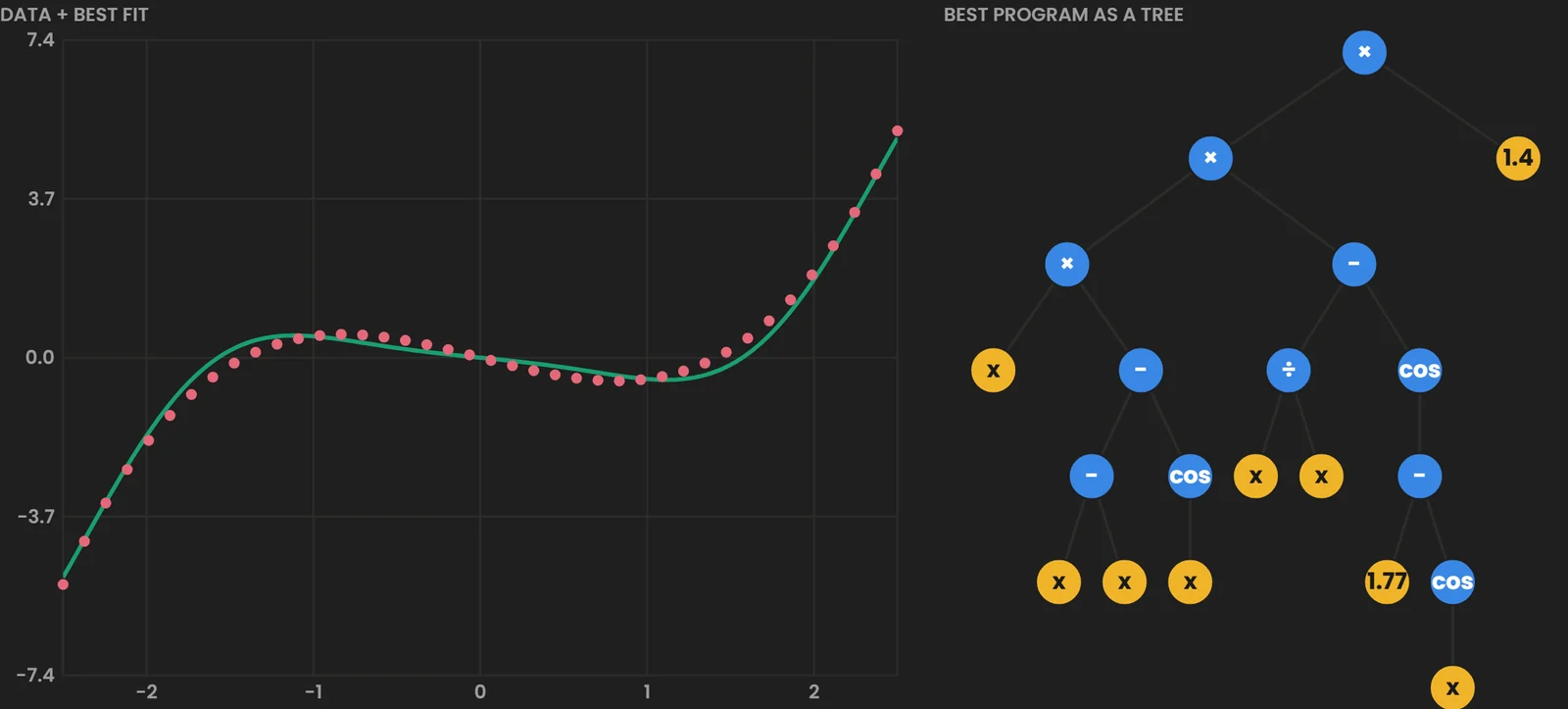
Evolutionary Computation is having an identity crisis in the GenAI era, despite delivering major real-world wins in engineering, logistics, and constrained optimization.
Photograph © Ken Reid
Evolutionary Computation's Identity Crisis in the Age of GenAI
I have spent my entire academic and professional life steeped in the world of Evolutionary Computation (EC). From grinding through my PhD and postdocs onward, I've used these algorithms to solve both massive real-world industrial and complex theoretical problems. I have seen firsthand what these systems can do.
Before we get into the current crisis facing the field, I have to confess my love for the biology that started it all. The biological world is staggeringly complex, but the mechanisms driving that complexity are surprisingly simple. John Holland, the pioneer of genetic algorithms, realized decades ago that we could borrow evolution's trick for software: maintain a population of candidate solutions, keep the ones that work, mutate and recombine them, repeat. It seems obvious in hindsight, but simple ideas are often the most brilliant.
Quick jargon guide (expand)
If you are new to EC, these are the terms that matter most in this piece:
- Metaheuristic: a high-level search strategy (like GA, PSO, SA) used when provably optimal methods are too expensive.
- Evolutionary Algorithms (EAs): a family of metaheuristics inspired by evolution; they iteratively improve a population of candidate solutions.
- Combinatorial Search Space: problems made of discrete choices (routes, schedules, component sets), where combinations explode quickly.
- Fitness / Objective Function: the scorecard used to judge each candidate solution against the real goal.
- Hard Constraints: non-negotiable rules (for example: weight limits, delivery windows, safety bounds) that must be satisfied.
- Selection, Crossover, Mutation: selection keeps stronger candidates; crossover mixes useful parts; mutation adds variation so search does not get stuck early.
- Non-differentiable Objective: a goal function with no useful gradient, so gradient descent is unreliable or impossible.
- Multi-objective Optimization: optimizing several competing goals at once (for example: cost, speed, and reliability).
- Surrogate Model: a cheaper approximation of an expensive evaluator (for example, replacing some simulations with a learned predictor).
Lately, if you look at the AI landscape, you could be forgiven for thinking neural networks and GenAI are the only games in town. The hype, funding, and conference mindshare all flow toward whatever has the most product momentum. Meanwhile, Evolutionary Computation is experiencing an identity crisis.
While everyone's arguing about whether ChatGPT will take their job, evolutionary algorithms are already running the logistics that get their packages delivered.
Why EAs still matter
GenAI relies heavily on gradient-based optimization in continuous spaces. But what happens when there is no useful gradient, no data to work with, or when the solution space is highly constrained and combinatorial?
That is where EAs shine. They need neither smooth, differentiable landscapes nor large amounts of labeled data, and they thrive in noisy, constrained environments. Unlike the opaque behavior of large language models, evolutionary mechanisms are transparent, constraints are explicit, and engineers can inspect trade-offs directly rather than accepting a plausible but unverifiable output.
The receipts: real-world impact
If you want to know why I still have one foot planted in this research, look at the ROI:
Aerospace engineering: General Electric has used genetic algorithms with fluid dynamics simulations to optimize turbine blade geometry, with reported fuel-efficiency gains in the 0.5% to 1% range, translating to very large fleet-lifetime savings.[1][2][3]
Space exploration: NASA's ST5 X-band antenna design is a classic example where a genetic algorithm evolved non-intuitive geometries that met strict size, weight, and power constraints better than human-designed alternatives.[4][5]
Global logistics: large routing systems (DHL, UPS, Amazon-scale operations) use evolutionary and hybrid metaheuristics nightly to cut mileage and fuel use while obeying hard constraints such as shifts, traffic, weather, and service windows.[6][7][8]

© Ken Reid. All rights reserved. EAs impact real world logistics, research, industry and beyond.
What GenAI cannot do
Given the examples above, you might reasonably ask: could you not just prompt an LLM to design a turbine blade or plan a delivery route? The short answer is no, and the reasons are instructive.
GenAI models are fundamentally interpolation engines.[17] They are trained on existing human output and generate plausible-looking responses that blend what they have seen. That is extraordinarily powerful for text, code, images, and conversation. But it is not optimization. A large language model asked to design an antenna geometry will produce something that looks like an antenna. It will not produce something that satisfies specific gain, weight, and power constraints while minimizing material cost, because it has no way to enforce hard constraints or evaluate physical feasibility.[18]
EAs operate differently. Each candidate in the population is evaluated against a real objective function (which can include simulations, physical models, or constraint checkers), and the search improves iteratively through selection, mutation, and recombination.[19] The constraints are enforced at every generation.
This is not a competition between the two. GenAI and EAs solve fundamentally different classes of problem. The issue is that funding, attention, and hiring all follow the hype, and right now the hype is entirely on one side.[20] EC researchers are not losing on technical merit. They are losing on marketing.
The naming problem
Despite these wins, EC struggles for prestige, and not all of that is external hype. A meaningful part is self-inflicted: the field's long-running habit of presenting familiar search mechanics as "new" algorithms by wrapping them in vivid metaphors. Campelo and Aranha call this the Evolutionary Computation Bestiary, and the label is accurate.[9]
The pattern is now well documented. Algorithms branded around wolves, whales, moths, fireflies, bats, antlions, and similar themes are often introduced with novel biological stories, but their actual update rules map onto known metaheuristic building blocks already present in earlier work.[10][11][12] The issue is not that inspiration is bad. The issue is that metaphor can obscure how an algorithm works.
Concrete examples from the critiques include:
- Grey Wolf Optimizer / Whale Optimization / Firefly / Bat / Antlion variants: often presented as distinct families, but deconstructions show strong structural overlap with pre-existing attraction-repulsion, random walk, and population update templates.[10]
- Cross-paper naming inflation: identical or near-identical operators are relabeled as new domain-specific behaviors, making cross-method comparison harder than it should be.[11][12]
- Bestiary expansion: the metaphor pool has expanded far beyond animal behavior into broader symbolic themes, increasing semantic noise without a matching increase in mathematical novelty.[9]

© Ken Reid. All rights reserved. Novel branding is easy; demonstrating operator-level novelty is the hard part.
Harmony Search is the canonical cautionary tale. It was introduced with a compelling music metaphor, where improvisation in a harmony memory supposedly yields novel optimization behavior.[13] Later analyses by Weyland showed that, in operational terms, the method is a special case of established Evolution Strategies and can be less efficient in practice.[15][16]
- Harmony Memory corresponds to a standard population store.
- Improvisation maps to familiar sampling/recombination behavior.
- Pitch Adjustment behaves like local mutation or perturbation.
The scientific cost is straightforward: when operator equivalence is hidden behind metaphor, researchers spend time "improving" renamed algorithms instead of accumulating comparable evidence on shared mechanisms. The result is duplicated effort, noisy benchmarks, and slower cumulative progress.[10][11][12]
The dialect collision
The metaphor problem is internal to EC, but the fragmentation extends outward too. EC and mainstream ML often describe the same core mathematical concepts in entirely different dialects. Researchers can be tuning the same underlying parameters while calling them by completely different names:
| Concept | EC term | ML term |
|---|---|---|
| Global objective | fitness | reward, utility, or loss |
| Search space | fitness landscape | loss surface |
| Dataset / state | population | batch or ensemble |
| Time and iteration | generations | epochs |
| Exploration | mutation | exploration noise, perturbation |
| Information sharing | crossover | parameter averaging, gradient sharing |
| Solution retention | elitism | best-model checkpointing |
This disconnect means literature reviews rarely cross-pollinate. Advancements in one community are frequently ignored by the other until they are independently rediscovered.
The problem gets worse in mathematically sophisticated subfields, and this next bit is niche, but it illustrates the point well. Quantum-Inspired Evolutionary Algorithms (QEAs), for instance, run on classical computers but borrow quantum nomenclature: qubits, superposition, rotation gates.[14] In practice, these often map directly onto existing probabilistic search methods like Estimation of Distribution Algorithms (EDAs) and PBIL.[12] By wrapping classical probability updates in quantum language, parts of the QEA literature become semantically isolated from the very research they are building on.
The cost of all this fragmentation is real. When a researcher tuning a Q-gate, a researcher tweaking Pitch Adjustment, and an ML engineer adjusting exploration noise do not realize they are studying closely related perturbation mechanisms, the broader community loses opportunities for unified progress. The illusion of rapid innovation masks what is often scientific stagnation through relabeling.
EC in the GenAI era
Here is what I find frustrating: the GenAI wave is pulling attention away from EC while creating the kind of problems that EAs are built to solve. Neural architecture search, hyperparameter optimization, prompt engineering at scale, constrained code generation, multi-objective model selection: these are all optimization problems with messy, non-differentiable, or combinatorial search spaces. EAs should be central to the next generation of AI systems, not sidelined by them.

Hybrid approaches are already emerging. Researchers are using LLMs as surrogate fitness evaluators, letting evolutionary search explore design spaces while a language model provides fast approximate evaluations. Others are using EAs to evolve prompts, tune retrieval-augmented generation pipelines, or search for adversarial inputs that expose model weaknesses. The combination of GenAI's generative fluency and EA's constraint-respecting optimization is powerful, and it is still early days.
But for EC to claim that seat at the table, the field has to get its house in order. The naming crisis and the dialect collision are not just academic annoyances. They are the reason EC papers do not show up in ML literature reviews, the reason industry labs do not consider evolutionary approaches, and the reason funding bodies see EC as a niche subdiscipline rather than a foundational tool. None of that reflects the quality of the underlying science; it reflects how the field communicates it.
The path forward

Evolutionary Computation does not need another metaphor. It needs an operator-level ontology and a semantic translation layer that maps algorithm families onto fundamental mathematical components. In plainer terms: a shared vocabulary that maps what each community actually means when they use different words for the same things. That is how we compare methods fairly across communities.
We also need to normalize publication of negative results. If a popular algorithm fails on a class of problems, publishing that failure can save others months of wasted effort and improve collective progress.
EC is uniquely equipped for non-differentiable, highly constrained, real-world optimization. Clean up the language, tighten the science, and the field does not just survive the GenAI era, it becomes foundational to what comes next.
Common questions
Are EAs obsolete now that deep learning is dominant?
No. Deep learning dominates many perception and generation tasks, but EAs remain strong for constrained optimization, combinatorial search, and engineering design where gradients are unavailable or unreliable.
What is the biggest practical issue in EC research today?
Comparability and reproducibility. Inconsistent naming, weak ablation studies, and limited negative-result publication make it harder to identify genuine advances.
Can EC and modern ML be combined effectively?
Yes. Hybrid systems are already common, for example using learning-based surrogates with evolutionary search, or using evolutionary strategies for policy optimization in reinforcement learning settings.
References
- Tong, C., Powell, D., & Skolnick, M. M. (1989). Engineering design optimization using genetic algorithms. In Proceedings of the 3rd International Conference on Genetic Algorithms.
- Shelton, M. L., et al. (1993). Application of a genetic algorithm to turbomachinery airfoil design. In ASME Turbo Expo Proceedings.
- Oyama, A., Liou, M.-S., & Obayashi, S. (2004). Transonic wing design based on evolutionary algorithms coupled with Navier-Stokes solvers. AIAA Journal.
- Hornby, G. S., Lohn, J. D., & Linden, D. S. (2011). Computer-automated evolution of an X-band antenna for NASA's Space Technology 5 mission. Evolutionary Computation, 19(1), 1-23.
- Lohn, J. D., Hornby, G. S., & Linden, D. S. (2004). Evolutionary antenna design for a NASA spacecraft. In Proceedings of the Genetic and Evolutionary Computation Conference (GECCO).
- Holland, O., Leff, J., Chappell, A., & Dietrich, B. (2017). ORION: UPS's integrated on-road optimization and navigation. Interfaces, 47(1), 8-23.
- Korte, B., & Vygen, J. (2018). Combinatorial Optimization: Theory and Algorithms (6th ed.). Springer.
- Kool, W., van Hoof, H., & Welling, M. (2019). Attention, learn to solve routing problems! In International Conference on Learning Representations (ICLR).
- Campelo, F., & Aranha, C. (2023). Lessons from the Evolutionary Computation Bestiary. Artificial Life, 29(4), 421-432. doi:10.1162/artl_a_00402
- Camacho-Villalon, C. L., Dorigo, M., & Stutzle, T. (2022). Exposing the grey wolf, moth-flame, whale, firefly, bat, and antlion algorithms: six misleading optimization techniques inspired by bestial metaphors. International Transactions in Operational Research, 30(6), 2945-2971. doi:10.1111/itor.13176
- Sorensen, K. (2015). Metaheuristics-the metaphor exposed. International Transactions in Operational Research, 22(1), 3-18. doi:10.1111/itor.12001
- Lones, M. A. (2019). Mitigating Metaphors: A Comprehensible Guide to Recent Nature-Inspired Algorithms. SN Computer Science, 1. doi:10.1007/s42979-019-0050-8
- Geem, Z. W., Kim, J. H., & Loganathan, G. V. (2001). A new heuristic optimization algorithm: harmony search. Simulation, 76(2), 60-68.
- Han, K. H., & Kim, J. H. (2002). Quantum-inspired evolutionary algorithm for a class of combinatorial optimization. IEEE Transactions on Evolutionary Computation, 6(6), 580-593.
- Weyland, D. (2010). A rigorous analysis of the harmony search algorithm.
- Weyland, D. (2015). A critical analysis of the harmony search algorithm-How not to solve sudoku. Operations Research Perspectives, 2, 97-105.
- Chollet, F. (2019). On the measure of intelligence. arXiv preprint arXiv:1911.01547. arXiv:1911.01547
- Kambhampati, S., Valmeekam, K., et al. (2024). LLMs can't plan, but can help planning in LLM-modulo frameworks. Communications of the ACM. CACM article
- Hornby, G. S., Globus, A., Linden, D. S., & Lohn, J. D. (2006). Automated antenna design with evolutionary algorithms. In Space 2006 Conference and Exposition. NASA NTRS
- Marcus, G. (2022). Deep learning is hitting a wall. Nautilus. Nautilus article
Cite this post
If you reference this post in academic or professional work:
@misc{reid2026ecidentity,
  author = {Reid, Kenneth N.},
  title  = {Evolutionary Computation's Identity Crisis in the Age of {GenAI}},
  year   = {2026},
  url    = {https://www.kenreid.co.uk/blog/evolutionary-computation-identity-crisis.html},
  note   = {Blog post, accessed YYYY-MM-DD}
}
APA: Reid, K. N. (2026). Evolutionary Computation's Identity Crisis in the Age of GenAI. kenreid.co.uk. https://www.kenreid.co.uk/blog/evolutionary-computation-identity-crisis.html