Data & AI · · 6 min read
Ant Colony, Live
An interactive ant colony optimiser in your browser: watch a shortest path emerge from thousands of tiny, blind, local decisions, and see what evaporation is really for.
Ant Colony, Live
This search strategy is about something strange and, to me, a fascinating trick we have learned from observing and being inspired by nature: a shortest path found by thousands of blind agents, not one of which has any idea what it's doing.
Real ants find the shortest route between nest and food with no map, no memory to speak of, and no leader. Each ant follows two dumb rules: wander, biased toward the smell of pheromone, and drop pheromone as you walk. And yet the colony reliably solves a problem no individual ant could even represent. The intelligence isn't of the ants, it's emergent.
Quick jargon guide
- Ant Colony Optimization (ACO): an optimiser inspired by foraging ants, where many simple agents build solutions and reinforce good ones with virtual "pheromone".
- Stigmergy: coordination through the environment rather than direct communication. Ants don't talk; they edit a shared chemical map, and the map tells the next ant what to do.
- Pheromone: a virtual scent deposited on good path segments. It marks routes that worked, biasing future ants toward them.
- Evaporation: pheromone fading over time. Without it, early mistakes get locked in forever; it's the colony's way of forgetting.
- Exploration vs exploitation: the balance between following strong trails (exploit) and trying new paths (explore). A tunable weight.
- Emergence: a behavior exhibited in colonies or groups of organisms that provides solutions without any individual understanding the problem.
How dumb agents get smart together
Many ants set out at random. Shorter routes get walked end-to-end faster, so an ant on a short route completes more trips in the same time, so it lays pheromone more often per unit time. The short route therefore accumulates scent faster than long ones. The next wave of ants, biased toward scent, is more likely to pick it, which lays yet more scent, which biases yet more ants. A positive feedback loop amplifies whatever's working.
Left unchecked, that loop would be a disaster: the first route to get lucky would snowball and lock in, good or not. So evaporation is essential. Scent fades, so a route has to keep proving itself to stay attractive; a stale trail to a mediocre route decays away and frees the colony to find something better. Reinforcement finds good solutions; forgetting stops the colony being stuck with the first trail. Marco Dorigo formalised all this in the early 1990s[1], and it turned out to be competitive on routing problems (think Amazon deliveries, Google maps, etc.)
Watch the trail form
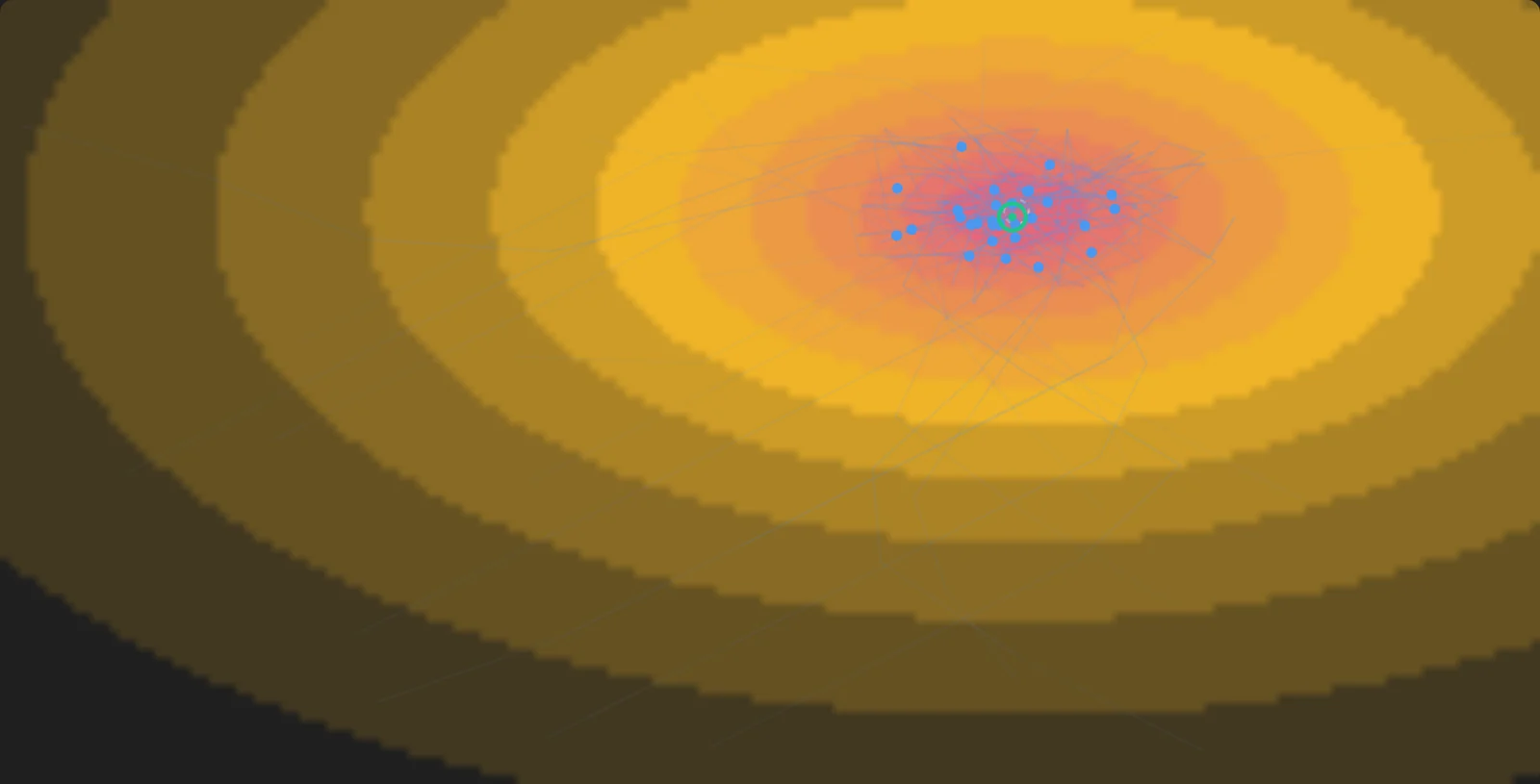
Below, a colony is foraging on a small map. Watch the pheromone (the glow on the paths) start uniform and noisy, then sharpen, as one route out-competes the others and the colony pours itself onto it as an emergent behavior.
Drag anywhere on the map to move the food to the nearest node and watch the colony re-route.
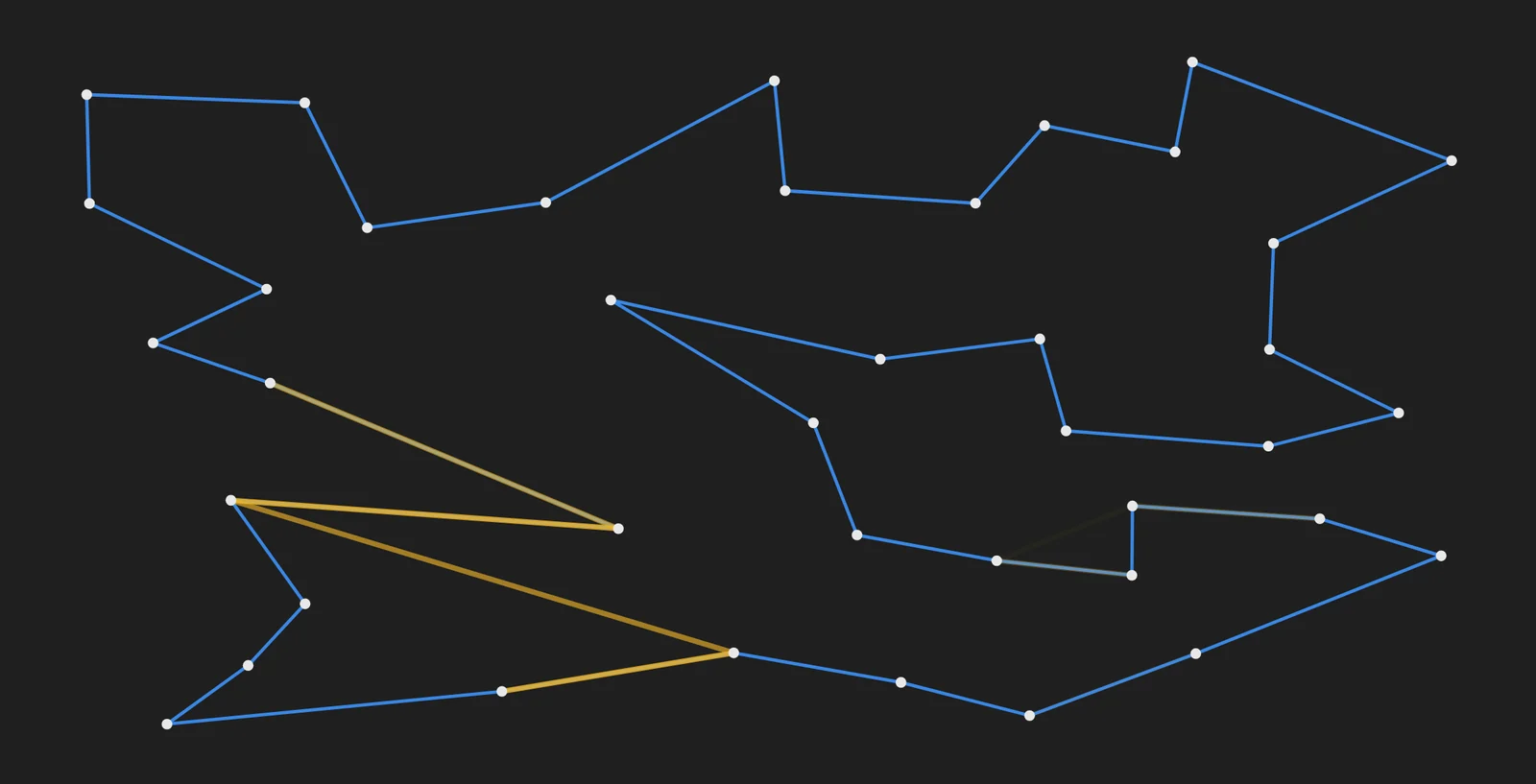
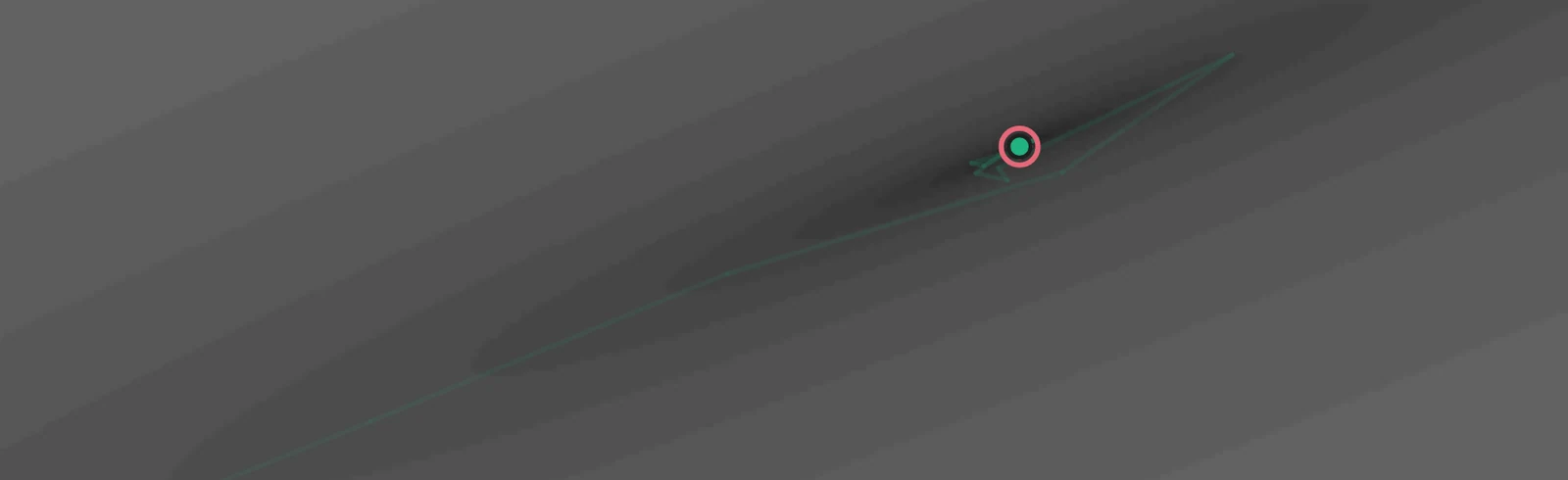
Pheromone (the amber glow) is the shared memory; the green line is the route the colony currently agrees on. Route numbers are multiples of the shortest possible path, so 1.00× is perfect; pheromone focus is how much of the smell sits on a few trails, and it climbs as the colony commits. Double bridge is the classic lab experiment (two routes, one shorter); City grid offers many equally good routes, so watch the colony break the tie and commit to one anyway; in the Maze, watch evaporation erase the trails that lead into dead ends; and in the Spider web, the colony discovers that the fast way around is through the middle.
A colony that can't forget
Turn evaporation off. The colony commits, hard and early, to whatever route happened to get the first head start, and then it's stuck there forever even when a shorter path is sitting right next to it. This is premature convergence. A colony that can't forget can't improve.
Turn evaporation up to maximum. Now the opposite: trails vanish before they can build, the colony never commits to anything, and the ants wander like it's the first minute forever. Memory that's too short is as useless as memory that's too long. The sweet spot between them is key - interesting thought, right?
Crank exploration. Push the ants to ignore the trails and strike out on their own, and watch a fascinating trade: the colony becomes slow to lock onto the best route but much better at noticing when the world changes (drag the food and see). Low exploration is fast and brittle; high exploration is slow and adaptive.
Why "no one is in charge"
The thing I most want you to take from watching this is the absence at the centre. There is no queen ant in charge. There is no scout ant specialized in picking up distant scents that knows the route. If you interrogated every single ant, none could tell you the solution, because the solution isn't stored in any ant: it's stored in the environment, in the pattern of scent, edited a little by each passing insect and read a little by the next. Intelligence, here, is a property of the system, not any of its parts.
Starlings do it in the sky, neurons do it in your skull, markets do it (imperfectly), and it's the reason I find swarm methods fascinating. We're used to thinking capability requires a capable agent: a smart ant, a smart boss, a smart model. Stigmergy says no. Get the local rules and the shared medium right, and competence can emerge from a crowd of things too simple to hold it individually. The same process that finds the food can also stampede a colony, or a market, or a comment section, straight off a cliff: emergence is not the same as wisdom.
Anyway. Go drag the food around and watch a thing with no mind change its mind.
Common questions
Do real ants actually do this?
The core process is real and was studied in actual ants (the classic double-bridge experiments showed colonies converging on the shorter branch via pheromone). The algorithm is still a simplification: real ant navigation also uses visual landmarks, path integration, and multiple pheromone types. As with the genetic algorithm, ACO borrows the idea as a metaphor; it's a faithful teacher of stigmergy and a loose model of entomology.
Is ant colony optimization actually used for anything?
Yes, mostly on routing and scheduling: network routing, vehicle routing, and various assignment problems, often hybridised with local search. It's rarely the outright best tool for a given problem (No Free Lunch), but it's competitive on dynamic problems where the environment keeps changing, because the evaporation-and-reinforcement loop naturally re-adapts, which is what you can watch when you drag the food.
References
- Dorigo, M., Maniezzo, V., & Colorni, A. (1996). Ant system: Optimization by a colony of cooperating agents. IEEE Transactions on Systems, Man, and Cybernetics, Part B, 26(1), 29–41. https://doi.org/10.1109/3477.484436